
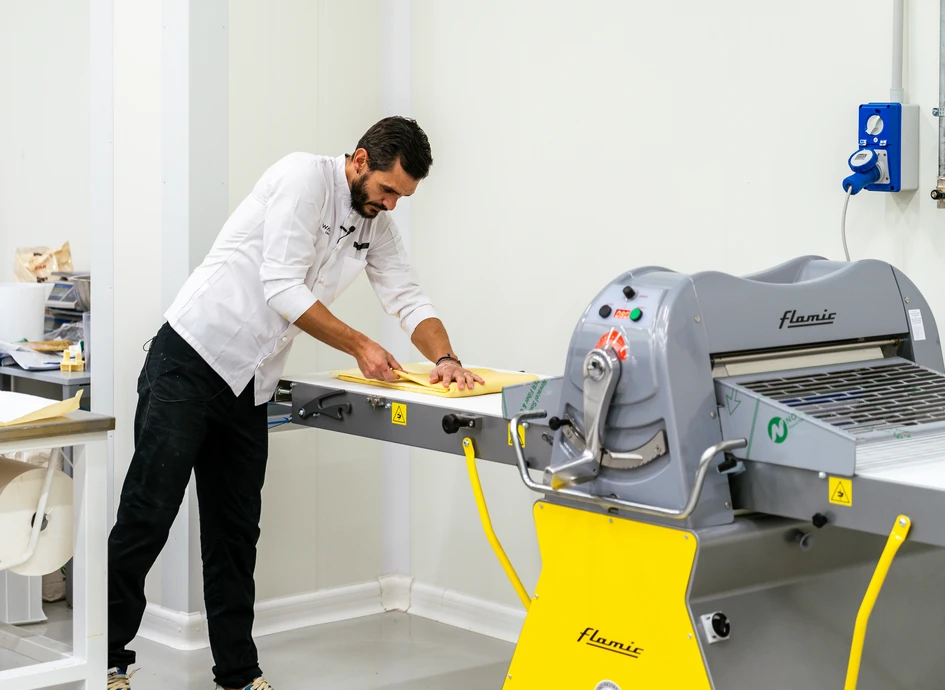
Croissants are built between the rollers. Dough and butter go into the sheeter together and come out, pass after pass, as thin continuous layers. When something is off, the dough shows it straight away: flakes of butter, a tear, a dough sheet that shrinks back.
Below are the faults you can see on the machine. For each warning sign there is a short analysis card: the signal on the dough sheet and its cause, followed by the adjustments to make in the process and on the sheeter.
A sheeter magnifies temperature and reduction mistakes
By hand, you feel the dough resisting under the rolling pin. You stop and put it back in the fridge.
On a sheeter, the dough goes through the rollers in a moment. The rollers sit at the set gap and the dough goes through regardless. If the butter is too hard, it breaks. If the reduction is too big, the dough tears.
The machine repeats exactly what you ask of it, mistakes included.
So on a sheeter two things come first: the temperature of butter and dough as they go through the rollers, and how many millimetres you take off with each pass.
Butter breaking into flakes
What you see. Under the surface of the dough the butter forms separate patches. The layers are broken.
Cause. The butter is harder than the dough: the dough stretches, the butter cracks and shatters. It happens when the butter is too cold, or when the dough is much softer.
In the process. The butter goes into lamination at 12-14 °C. At that temperature it stays plastic and stretches along with the dough. The dough should reach the rollers at a working temperature close to the butter’s. Once the butter has broken, later passes will not join it back together.
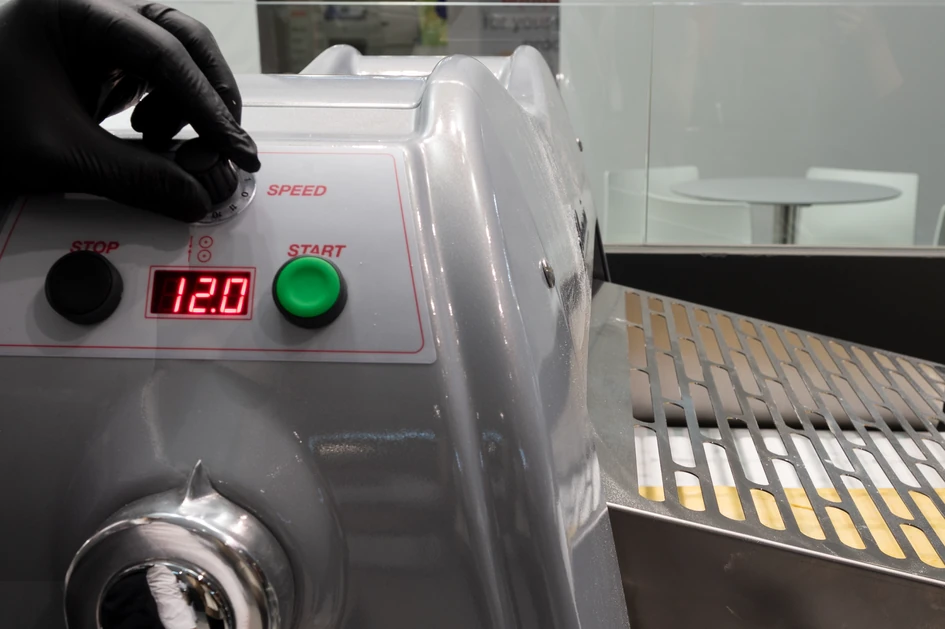
On the sheeter. The first passes are the most delicate: the block is still thick and the butter has only started to stretch. That is where you need small reductions. On the SF 450, SF 500 and SF 600, the digital display lets you see the thickness before every pass.
Dough tearing
What you see. The dough tears as it leaves the rollers, or thins at the edges until it breaks. Sometimes it sticks to the roller or the belt.
Cause. The usual ones:
- too much reduction in a single pass: the dough sheet is pulled further than the gluten can take;
- gluten still tight: the dough has not rested long enough after the previous fold;
- sticking dough: not enough flour between the dough and the rollers.
On the sheeter. Reduce in steps. On the SF models you set the thickness with the lever, the adjustable mechanical end stop holds the rollers at the chosen gap and the display confirms the figure. Several passes with small steps do less damage to the dough than one pass with a big jump.
Dust evenly. A flour tray comes as standard. On the FAST 700 the automatic flour duster adjusts the amount of flour it releases.
The FAST 700 also lets you change the speed ratio between the infeed and outfeed belts: that is the lever for managing tension in the dough sheet together with thickness. On the variable speed SF versions (VD and BVD) you adjust belt speed to match the pace of the dough to the work.
Dough shrinking after the pass
What you see. The dough leaves the rollers at the right thickness. A few moments later on the belt it gets shorter and thicker. You read one number on the display and find another when you cut.
Cause. Gluten is elastic and it has memory. If the dough is reduced over and over, tension builds up and the dough pulls back.
In the process. A cold rest, covered, between one series of passes and the next. How elastic the dough is gets decided even earlier, in the mixer.
On the sheeter. Forcing the last pass to make up for the shrinkage tightens the gluten again, so the dough shrinks back once more. Let it rest, then close to the final thickness. On the FAST 700 the sequence of passes is stored in the recipe, up to 97 passes per recipe: the same dough gets the same treatment every cycle.
Butter leaking and layers merging
What you see. During lamination the butter shows through the surface or runs out at the edges. In the oven the croissants leak butter onto the tray and the cross-section shows closed, blurred layers.
Cause. Butter too warm: it softens, mixes into the dough and the layers fuse. Or layers broken between the rollers by a sharp reduction: in the oven that is where the butter escapes. Too many folds also thin the layers until they blur into one another.
In the process. Butter at 12-14 °C when lamination starts. If the session runs long and the dough warms up, it goes back into the cold before you carry on. The room matters too. Butter leaking in the oven can also come from what happens after the sheeter, during proofing.
On the sheeter. The less time the dough sheet sits still on the belt, the less it warms up. Decide thicknesses and passes before you start: with the end stop already set on the SF, or with a recipe on the FAST 700, you are not hunting for the right gap with the dough in your hands. Lamination direction is reversed with a joystick or a pedal, depending on the model, so your hands stay free to guide the dough sheet.
Final thickness: measured, repeated
The final thickness of the laminated dough decides the shape of the croissant and how even it looks on the tray.
On the SF 450, SF 500 and SF 600 the digital display shows thickness in millimetres. The adjustable mechanical end stop fixes where the rollers close: the last pass always closes at the same thickness. The rollers open from 0.2 mm, up to 35 mm on the SF 450 and SF 500 and up to 37 mm on the SF 600.
On the FAST 700 thickness is read by an encoder and reduction is automatic. It holds up to 500 recipes, each with up to 97 passes. Monday’s croissants and Saturday’s come out of the same sequence.
Same thickness, from the first batch to the last.
Before the first pass
- Butter at 12-14 °C. Dough at its lamination temperature.
- A cool room. The dough stays out of the fridge only for the time of the passes.
- Clean rollers and scrapers. The scrapers come off easily.
- Flour in the tray, or the flour duster set on the FAST 700.
- Thickness sequence decided in advance: how many passes and at which millimetre each one closes. On the FAST 700 that is a recipe.
- Rests already planned between one series of passes and the next.
Try it with your own dough
How a sheeter handles your butter shows when your own dough goes under the rollers. WAICO LAB in Isola Vicentina is our group’s test facility: machines are tested there in real operating conditions, with your own recipes.
Request your trial: WAICO LAB
Lamination is one stage in making croissants. All the others, from mixing to baking: Croissants, stage by stage.
FAQ
What temperature should butter be for laminating croissant dough?
The butter goes into lamination at 12-14 °C. At that temperature it stays plastic and stretches along with the dough. Colder, it breaks into flakes; warmer, it mixes into the dough and the layers merge.
Why does croissant dough tear on a dough sheeter?
Usually the reduction in a single pass is too big, or the gluten has not rested after the previous fold. Sticking matters too: with too little flour the dough clings to the rollers and tears. On the sheeter you reduce in steps, checking thickness on the display, and the dough rests in the cold between one fold and the next.
Why do croissants leak butter in the oven?
Often the butter is too warm during lamination, or the layers have broken between the rollers because of a sharp reduction. In the oven the butter escapes from those points. Butter at 12-14 °C and gradual reductions are the first two things to check at the sheeter.
How do you get the same final thickness every production run?
On Flamic SF 450, SF 500 and SF 600 sheeters the digital display shows thickness in millimetres, and the adjustable mechanical end stop makes the last pass close at the same point every time. On the FAST 700 reduction is automatic: each recipe stores up to 97 passes, with up to 500 recipes.
Why does laminated croissant dough shrink after a pass on the sheeter?
Gluten is elastic: if the dough is reduced over and over, tension builds up and the dough pulls back, shorter and thicker. Forcing another pass pulls the gluten again. It is better to let it rest in the cold, covered, and then close to the final thickness.